

Colour Zoning: Creating Safer, Calmer, and More Efficient Healthcare Spaces
In healthcare environments, design choices go far beyond aesthetics. Every decision, down to the colour of walls and floors, can influence patient experience, staff efficiency, and even safety. One approach that’s becoming increasingly important in modern healthcare design is colour zoning.
By using colour strategically across hygienic wall cladding and flooring, healthcare facilities can create environments that are easier to navigate, more calming for patients, and better suited to clinical needs.
What is Colour Zoning?
Our PVC wall cladding is engineered to withstand the toughest environments without compromising on style. The Satins range is built to meet the highest standards, making it the
Colour zoning is the practice of using different colours to define or highlight specific areas within a space. In hospitals, clinics, and care facilities, this might mean:
- Marking out corridors, wards, or treatment areas through distinct flooring colours.
- Using colour to highlight entrances, exits, or key destinations.
- Using colours on walls in stairwells, corridors and bathrooms that contrast with handrails to help with navigation.
- Differentiating between “back of house” staff areas and public zones.
- Creating calming zones with softer tones in waiting rooms or patient bedrooms.
- Encouraging or discouraging movement into certain areas.
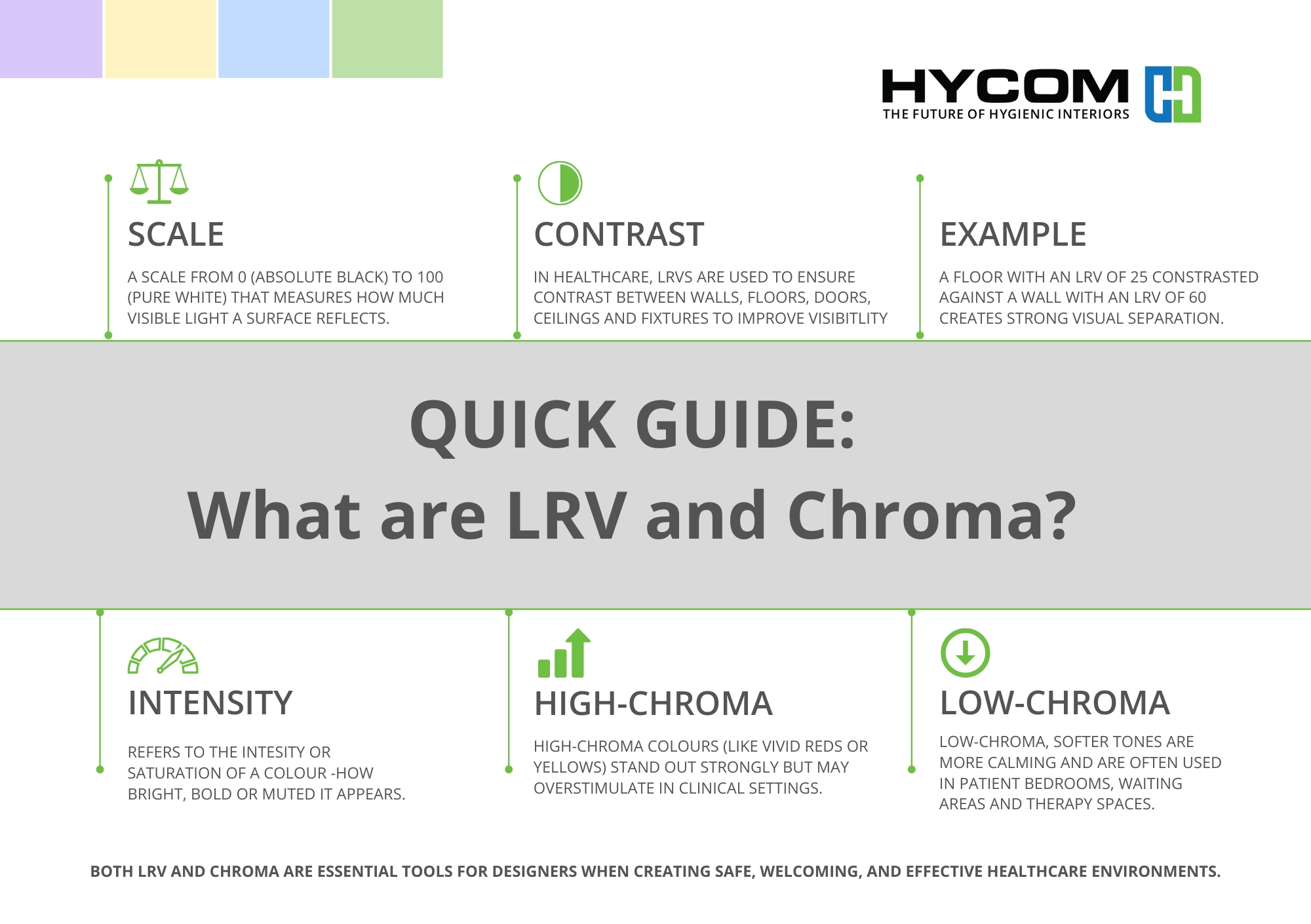
It’s not enough to consider colour alone with differentiating between areas. When the contrast between floors, walls, steps, doorways and fixtures and fittings is too subtle, it can cause uncertainty and possibly a fall. This is where Light Reflectance Values come into play. Every material has an LRV marked on a scale of 1-100 with 1 being dark (absorbing light) and 100 being light (reflecting light).
With hygienic wall cladding and flooring, colour zoning brings the additional benefit of infection control, because these materials don’t just look good, they are durable, easy to clean, and resistant to bacteria.
A bit about LRV and Chroma
Why is Colour Zoning Important in Healthcare?
1. Improved Wayfinding
Hospitals can feel overwhelming, particularly for patients and visitors who may be anxious or unwell. Clear colour-coded zones make navigation intuitive. They help reduce confusion, stress, and reliance on signage. For example, a corridor finished in a contrasting LRV to its adjoining walls makes direction clearer and boundaries more visible.
Colour can also discourage or discourage movement to/around a particular area. For example, darker areas on a floor can discourage foot traffic around an area to create a natural pathway. Bright colours can encourage movement towards the colour, for example to draw people to the end of a corridor.
2. Enhanced Patient Experience
Colour affects mood and perception. While stark white can feel sterile and cold, soft blues and greens can create a sense of calm, and warmer hues may encourage positivity and comfort. The chroma (intensity of a colour) plays a role here too. High-chroma colours like bright reds or yellows can overstimulate patients, whereas lower-chroma, muted shades promote a more soothing atmosphere.
3. Supporting Safety
Flooring colours and contrasts can highlight hazards or changes in levels, reducing the risk of slips and falls. FGI (Facility Guidelines Institute) Guidelines stipulate a minimum 30-point difference in LRV between adjacent surfaces (for example, between floors and walls or doors and frames) to ensure sufficient visual contrast for those with impaired vision. Similarly, flooring with a distinct chroma can help draw attention to areas where caution is required, such as staircases or wet rooms.
Using contrasting colours between handrails and walls can help visually impaired patients with wayfinding.
Conversely, where different types of flooring are used alongside each other and there is no step in between them, it’s important to ensure that the LRVs of the materials are 10 point variance or less. This avoids creating the illusion of a step where there isn’t one.
4. Staff Efficiency and Wellbeing
Colour zoning isn’t just for patients, it can help staff, too. Being able to quickly identify different departments or areas through colour coding streamlines movement, reduces mistakes, and makes high-pressure environments more manageable. High-LRV colours in circulation areas can also help reflect light more effectively, improving visibility and reducing fatigue.
How Hygienic Cladding and Flooring Support Colour Zoning
Traditional hospital designs often relied heavily on white surfaces to symbolise cleanliness. But with modern hygienic wall cladding and flooring, it’s possible to achieve both hygiene and design flexibility.
- Wide colour ranges mean designers can select products with specific LRVs and chroma values to meet both safety and aesthetic requirements.
- Durable, non-absorbent surfaces ensure that hygiene is never compromised.
- Custom colour schemes allow organisations to create clear zoning while aligning interiors with brand identity or care values. For example, take the dominant and contrasting colours of blue and white in the NHS colour palette which helps signpost people to NHS organisations and services.
Moving Towards Patient-Centred Design
As healthcare design continues to evolve, colour zoning is proving to be a vital tool in creating patient-centred, human-friendly environments. By combining the practical benefits of hygienic surfaces with the measurable properties of colour, like LRV and chroma, hospitals and clinics can create spaces that feel safer, calmer, and more connected.
Key Takeaway:
Colour zoning with hygienic cladding and flooring is more than a design choice, it’s a powerful way to improve navigation, safety, and wellbeing in healthcare facilities. By considering light reflectance values and chroma alongside hygiene and durability, healthcare spaces can achieve a balance of function, safety, and comfort.


